POST A: Designers and advertisements play important role in tobacco industry

Tobacco companies have enormous political and financial influence in Indonesia and are the third-largest source of revenue for the government (Reynolds, 1999). So, in Indonesia, tobacco companies have few policy restrictions. The number of young Indonesians is growing in recent years, with more than 45% Indonesians are under the age of 20. So, tobacco companies began to encourage young people to smoke by advertising and sponsoring large events. Designers and creative culture makers, such as artists, social media influencers or entrepreneurs, play a vital promotional role. They design the brand culture, packaging and advertising of cigarettes and spread them on social media and the Internet. As the second-largest Indonesian tobacco company, Sampoerna, rice: “The relevance to the consumer of a brand’s image and lifestyle will be the defining characteristic for success in the years to come.” (Reynolds, 1999) Designers associate cigarettes with lifestyle and personal characteristic, for example, strong masculinity and individuality are the predominant themes of cigarette advertising in Indonesia. And some ads, using highly successful men as examples, suggest that people can use cigarettes to attract women and become rich. Those tobacco advertisements deliver very misleading content – smoking means success, charming, courage, and popularity. These contents have great appeal to children and teenagers. Therefore, Advertising has had a very real impact on increasing the number of Indonesian smokers. Especially among young people, they are very concerned about their identity, so they are identified as the main contributors to the future profits of Indonesian tobacco companies.

An advertisement for Gudang Garam: “Kreteknya lelaki” (“The man’s cigarette”).

Because of the huge profits that advertising can bring, tobacco companies are putting more emphasis on investing in designers and producers of creative cultures. Cigarette companies sponsor almost all of the country’s concerts and sports events. (Dhumieres, 2019) All major Indonesian tobacco companies sponsor sporting events. (Reynolds, 1999) Tobacco billboards are prominently displayed and frequently changed in Yogyakarta. Yogyakarta government directly gets many benefits from cigarette revenues and the “social contribution” provided by the tobacco industry. Most of the small newsstands and shops in Yogyakarta are covered in tobacco advertising because tobacco companies offer cash payments and artwork to small shop owners. (Nichter et al., 2008) At the same time, cigarette companies sponsor many design companies and cultural and sports activities to obtain the support of designers and artists.

In Indonesia, it is difficult for designers and creatives to get financial assistance from the government or private sponsorship. However, tobacco companies serve them by controlling the design industry economically. But there is no denying that designers and creatives play a vital role in the spread of information on social media and the web. If the government can support designers, let them participate in anti-tobacco activities, I believe it can achieve good results.
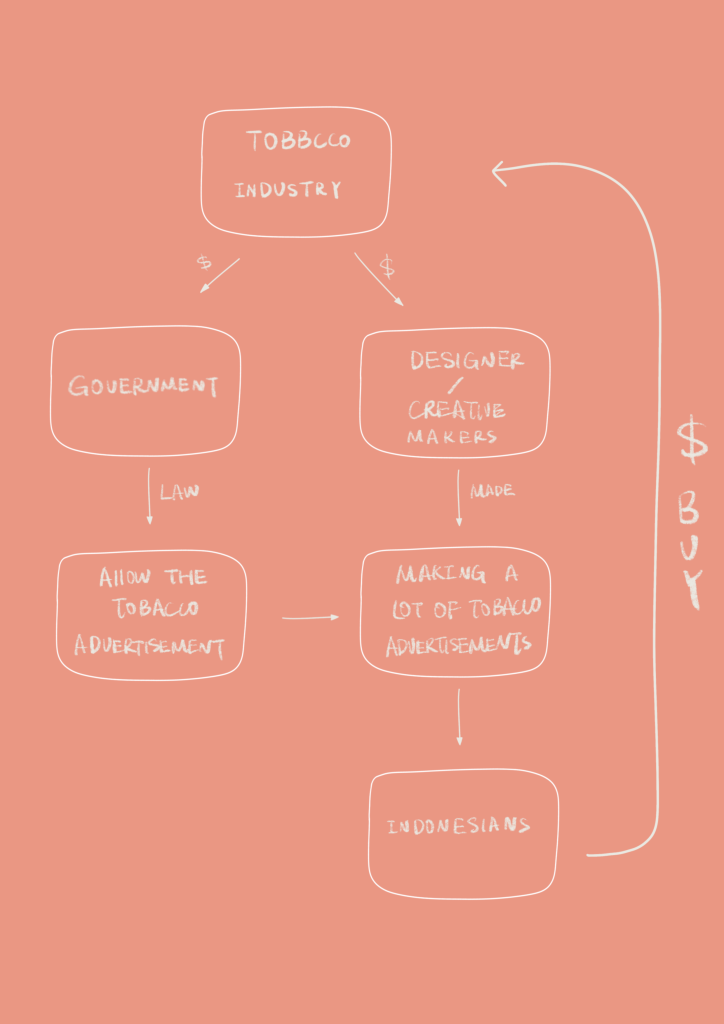
Diagram of connection

Reflection:

Dhumieres, M. 2019, The number of children smoking in Indonesia is getting out of control, Public Radio International. viewed 18 December 2019, <https://www.pri.org/stories/number-children-smoking-indonesia-getting-out-control>.

Nichter, M., Padmawati, S., Danardono, M., Ng, N., Prabandari, Y. and Nichter, M. 2008, Reading culture from tobacco advertisements in Indonesia, Tobacco Control, vol 18, no 2, pp.98-107,.REYNOLDS, C. 1999, Tobacco advertising in Indonesia: “the defining characteristics for success”, Tobacco Control, vol 8, no 1, pp.85-88,.

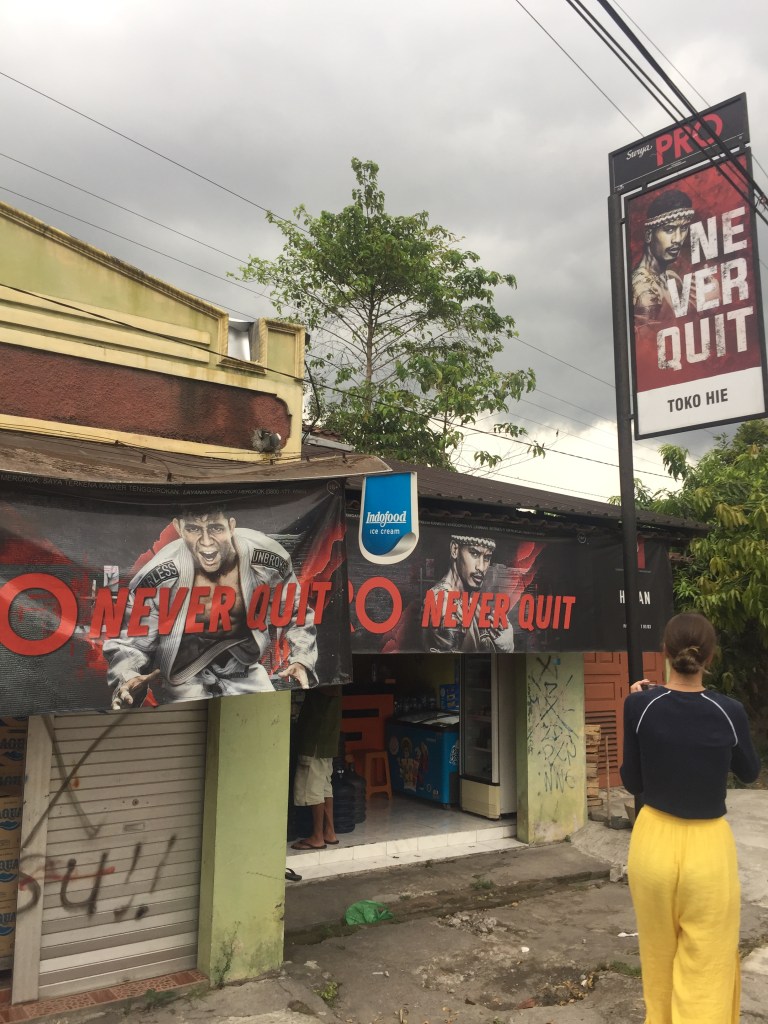
Reynolds, C. 1999, Tobacco advertising in Indonesia: “the defining characteristics for success”, Tobacco Control, vol 8, no 1, pp.85-88,.

POST A: Designing for the next generation

Design is a complex system often difficult to define. Design activism in particular gives shape to a cause in a way that’s easy to understand and embrace, acting as a sustained platform for change.(Miles, 2019) However, not all design can resolve issues, but instead unknowingly or purposefully contribute to them. In terms of Indonesia’s smoking epidemic, design is a vital tool effectively used to promote tobacco use, whether this be through the use of public space (billboards, banners outside shop fronts), social media and television campaigns, packaging or sponsorships and endorsements of major events. The tobacco industry has and continues to connect with designers and creative culture makers successfully, with the industry increasing their economic gain through their strategic and appealing advertising schemes targeting the youth; the next generation smokers.

In Indonesia, particularly Yogyakarta the presence of smoking advertisements are everywhere. It is surprising when there is a lack of. In Reynolds ‘Tobacco Control’ she shares “…visiting the country in early 1997, I was appalled by the enormous amount of billboard and point-of-sale advertising, indigenous and multinational, so prolific it almost became a “natural” part of the Indonesian landscape.” (Reynolds, 1997)

Smoking Campaign, Borobudur, 2019 (own photo)

Fast forward 22 years later, I share in Reynolds experiences in the sense not much has changed. The lack of advertising control has enabled the tobacco industry to continue to thrive, with it living proof of how impactful design really is. With the rise of a technological era, the exposure of such design is more far-reaching than ever before, from streets to television screens, to the sponsoring of public events, social media and Youtube – media outlets that are more commonly used by Indonesia’s youth.

Gudang Garam’s GG Mild brand Youtube advertisement (2017) clearly advocates the ‘new generation’ as their audience, promoting creativity along side tobacco. Smoking continues to be promoted as a ‘social activity’ or something that is considered ‘cool’, using works by designers as an engaging technique.

Gudang Guram GG Mild Advertisement, 2017

In 2016, Global Health Action conducted a survey with high-school students to investigate how youth perceived cigarette advertising. This study revealed that cigarette ads were perceived as encouraging youths to smoke and that smoking status was consistently associated with perception of cigarette ads. (Global Health Action, 2016)

Not only is the imagery a key aspect of design, but so is placement. Banner design in particular is placed on store fronts in close proximity to schools as a subtle yet strategic method to appeal to youth. (Lamb, 2018)

L.A Bold Cigarette Billboard on Yogyakarta street, 2019, (own photo)
Clas Mild Silver cigarette advertisement on vehicle down Yogyakarta street, 2019, (own photo)

Across Indonesia, more design activism for anti-smoking initiatives is needed. Design is both the problem and the solution, and it effects everything. (Crosby, 2016)

Crosby, A. 2019, ‘Design Activism in an Indonesian Village’, MIT Design Issues, vol. 35, no. 3, pp. 50-63, viewed 19 December 2019, < https://www.mitpressjournals.org/doi/pdf/10.1162/desi_a_00549>.

Medicine Man, How does design affect our lives?, marketing agency, London, viewed 20th December 2019, <https://medicine-man.net/2017/11/07/how-does-design-effect-our-lives/>.

Nichter, M., Padmawati, S., Prabandari, Y., Ng, N., Danardono, M. & Nichter, M. 2009, ‘Reading culture from tobacco advertisements in Indonesia,’ Tobacco Control, vol. 18, no. 2, viewed 20th December 2019, < https://tobaccocontrol.bmj.com/content/18/2/98 >.

Reynolds, C. 1999, Tobacco advertising in Indonesia: “the defining characteristics for success”, viewed 20th December 2019, <https://tobaccocontrol.bmj.com/content/8/1/85.short&gt;.

Yayi P., Arika, D 2016, US National Library of Medicine, How do Indonesian youth perceive cigarette advertising? A cross-sectional study among Indonesian high school students viewed on 20th Dec 2019,<https://www.ncbi.nlm.nih.gov/pmc/articles/PMC5005365/>

POST A: Two parties using design to their advantage

As designers, we hold far more responsibility than ever in this digital world where technology is relied on. A designer has the power to control how a space can be more hospitable and the way the general population consumes context (Role of design in society, chapter 1).

In Indonesia, the tobacco industry has used design to their advantage in order to boost tobacco consumerism. A tobacco company giant that has been notorious in pushing their kretek products to men through heavy graphics is ‘PT Gudang Garam’. In their graphics, they depict masculine men and this notion of masculinity has been further supported by their infamous slogan ‘Kretekeknya lelaki’, meaning ‘man’s cigarette’. This has been successful as more than 62% of their men smoke and 90% of are kretek smokers (Tobacco control, 2009). This graphic design as a form of advertising to a large demographic is dangerous in a country like Indonesia as it has not signed with the ‘WHO-FCTC’ (WHO, 2015) which means mainstream tobacco advertising coverage is still prevalent. So why are the deaths of these men ignored? The tobacco industry is one of the largest source of government revenue (Tobacco control, 2009) and with the backing of the government, the industry thrives.

Masculine graphic advertisement by Gudang Garam. Catherine Reynolds, 1999, Tobacco advertising in Indonesia: “the defining characteristics for success”, viewed 20 December 2019, https://tobaccocontrol.bmj.com/content/8/1/85

The continuous use of political power and design, Gudang Garam held a rock competition in 2007 and a rock festival called Rockinland in 2011. These festivals were again targeted at males, as all of their graphic promotional materials depicted rock symbols which were masculine. Apart from that, Rockinland’s lineup were male rockstars to further portray this lifestyle of ruggedness. Similarly, the Jakarta open which was a male’s tennis event was also sponsored by the tobacco industry. Drawing considerations starting from as simple as masculine graphics to enlisting only male stars ultimately is clever design as each element is cohesively attractive to their male target market.

A graphic poster showcasing Rockin’land’s male dominated lineup. Cranberriesworld, 2011, ‘Rockinland festival lineup’, viewed 20 December 2019, http://cranberriesworld.com/live/concerts/java-rockinland-festival-2011-2011-07-23/.

A communal organisation however, has used this design formula to advocate for a more sustainable future. ‘Kartel Awul Yogyarkata’ holds events targeted at youths, predominately males with their primary focus on encouraging them to trade and sell used clothing. The events are generally held at the few skateparks alongside local punk bands in order to appeal to this demographic. Similarly, they advertise graphically through their cult online presence. Although these events do not have primary involvement with tobacco, they do have anti-smoking zones in the larger areas of these events such as the foodcourt and the thrift stalls which can discourage general smoking there.

A band playing at the Kartel Awul YG event I attended, 2019.
stakeholder map and chain to vaguely show the relationship both parties share with government and people of Indonesia, 2019.

Catherine Reynolds, 1999, Tobacco advertising in Indonesia: “the defining characteristics for success”, viewed 20 December 2019, https://tobaccocontrol.bmj.com/content/8/1/85

Cranberriesworld, 2011, ‘Rockinland festival lineup’, viewed 20 December 2019, http://cranberriesworld.com/live/concerts/java-rockinland-festival-2011-2011-07-23/.

Mimi Nitcher, 2009, ‘Reading culture from tobacco advertisements in Indonesia ‘, tobaccocontrol, viewed 20 December 2019, https://tobaccocontrol.bmj.com/content/18/2/98.

SEATCA, 2010, ‘International artists performing at Indonesian tobacco-sponsored rock festival despite protests’, viewed 20 December 2019, https://seatca.org/international-artists-performing-at-indonesian-tobacco-sponsored-rock-festival-despite-protests/.

World health organisation, 2015, ‘Tobacco control in Indonesia’, WHO, viewed 20 December 2019, https://www.who.int/tobacco/about/partners/bloomberg/idn/en/.

POST B: Does media actually influence tobacco consumerism?

Tobacco usage was a symbol of status growing up as it debuted on Malaysian mainstream media, broadcasting on national television. A notable advertisement which stuck with me was the Malboro one where in the advertisement, you were promised a lifestyle like the one portrayed by the rugged men on horses smoking chased by beautiful women. 11-year-old me would find myself in a dilemma as I pondered why smoking became something so attractive despite the fatal consequences.

Although the society we live in now is more educated about tobacco consumerism, smoking related mortality rates are still prevalent. In 2015, it is said that ‘2.5 million Australians smoke daily’ (Australian Bureau of Statistics. Australian Healthy Survery 2014/15). In America, about ‘480,000 people’ die from smoking (Centers for disease control and prevention, 2018).

Smoking rates in America, 2018.
Centers for disease control and prevention, 2018, ‘Morbidity and Mortality Weekly report’, viewed 19 November 2019, <https://www.cdc.gov/mmwr/volumes/67/wr/mm6702a1.htm>.

A decade later from my childhood, instead of glamorising tobacco consumerism, I witnessed mainstream media enter a new age as it is now used to tackle it instead. In 2012, America saw ‘the first-ever paid national tobacco education campaign’ by the Centers of Disease Control and Prevention (CDC). The campaign named ‘Tips’ (Tips from former smokers) funded by Affordable ACT care follows and documents real ex-smokers in their deteriorated state as a result from long term smoking. ‘Tips’ primary goal is to create awareness to the risks that smoking holds. Due to the campaign’s success, it has been continued to date. This year, ‘tips’ went further with their initial theme by also including people who have been affected by second-hand smoke.

Their success is owed to the use of highly graphic material in the campaign, as these ex-smokers being documented are essentially on their death beds in worst case disfigured conditions. This plays on the emotions of viewers, often prompting them to be afraid as they empathise in shock. Explicit graphic ads like ‘tips’ have become more common as they are deemed effective if the target client is human. In fact, an academic study by the Cambridge University research team carried out a shock campaign of their own primarily using fear. They found that using this in advertisements ‘significantly increases attention, benefits memory and influences behaviours among students’ (Cambridge university press, 2003).

A screenshot of a before and after of an ex-smoker Terrie from a ‘Tips’ advertisement.
Centers for Disease Control and Prevention (CDC), 2014, ‘CDC: Tips From Former Smokers – Terrie: Teenager Ad’, Youtube video, viewed 19 November 2019, <https://www.youtube.com/watch?v=_th5U5hRu8k>.

Perhaps ‘shock advertising’ could be endorsed more in locations like Central Java instead where tobacco usage is still promoted as a luxury all over Indonesia.

But despite innovate campaigns like ‘tips’, how much can these advertisements impact addicted smokers? Especially if it is only presented via online/tv media which can often be inaccessible.

References:

CDC, 2019, ‘The Burden of Tobacco Smoking’, viewed 19 November 2019, <https://www.cdc.gov/tobacco/campaign/tips/about/index.html>.


Centers for Disease Control and Prevention (CDC), 2014, ‘CDC: Tips From Former Smokers – Terrie: Teenager Ad’, Youtube video, viewed 19 November 2019, <https://www.youtube.com/watch?v=_th5U5hRu8k>.

DARREN W. DAHLKRISTINA D. FRANKENBERGE and RAJESH V. MANCHANDA, 2003, ‘Does It Pay to Shock? Reactions to Shocking and Nonshocking Advertising Content among University Students’, University of Cambridge, viewed 19 November 2019, <https://www.cambridge.org/core/journals/journal-of-advertising-research/article/does-it-pay-to-shock-reactions-to-shocking-and-nonshocking-advertising-content-among-university-students/9899C853E05CE5ED577F03314E27E01F>.


Heart foundation, 2015, ‘Smoking statistics’, Australian Bureau of Statistics, viewed 19 November 2019 < https://www.heartfoundation.org.au/about-us/what-we-do/heart-disease-in-australia/smoking-statistics&gt;.

Hunter Stuart, 2013, ”Tips From Former Smokers’ Ad Campaign Caused 100,000 Smokers To Quit, CDC Estimates’, Huffington Post, viewed 19 November 2019, <https://www.huffingtonpost.com.au/2013/09/10/tips-from-former-smokers-cdc_n_3901167.html>.

Gilling school of public health, 2017, ‘Study evaluates the CDC’s Tips From Former Smokers campaign, finds it an effective smoking cessation program’, viewed 19 November 2019, <https://sph.unc.edu/sph-news/study-evaluates-the-cdcs-tips-from-former-smokers-campaign-finds-it-an-effective-smoking-cessation-program/>.

Post D: Indonesia’s Omnipresent Tobacco Culture

Traces of tobacco exist in every crevice of Ambon: used cigarette butts discarded on the sidewalk; empty cigarette packets floating in the river; Ambonese men smoking along the streets; and the smell of tobacco wafting through the air – all constant reminders of tobacco’s long history in Indonesia, rich with cultural symbolism and associations that existed before the advent of advertising (Reynolds 1999). Perhaps the most jarring, and arguably the most noticeable, aspect of tobacco culture is the plethora of tobacco advertising that densely saturates the Indonesian landscape.

Hand-drawn map of a walk in Ambon observing tobacco advertisements

On a short walk around Ambon – through quiet residential areas, the bustling market, and busy main roads – it is quickly evident that one can barely walk a few metres without seeing cigarette advertisements plastered on cloth banners, wall posters or big billboards (Nichter et al. 2009).

Photographs taken during a walk around Ambon, Indonesia

The frequency in which these tobacco advertisements appear is appalling, and Indonesia’s alarming smoking statistics can in part be attributed to the aggressive and innovative cigarette marketing prevalent in Ambon and other parts of Indonesia (Nichter et al. 2009). In the city of Yogyakarta in Central Java, tobacco billboards are displayed prominently, and most small kiosks and shops are covered with tobacco advertisements – which concurs with the advertising landscape in Ambon as well, as seen from the images above (Nichter et al. 2009). Similarly, in Denpasar, Bali, it was found that 7 out of 10 retailers displayed at least one banner promoting cigarette products (Astuti & Freeman 2018). The combination of persistent advertising and readily available and affordable cigarettes, among other social and cultural factors, has resulted in over 62% of Indonesian males smoking regularly, and boys as young as 10-years-old beginning to smoke (Achadi, Soerojo & Barber 2005).

Although the dense saturation of tobacco advertising in Indonesia is shocking to witness, the most worrying aspect, however, is how these advertisements are seamlessly integrated into the Indonesian landscape and tobacco becomes synonymous with Indonesian culture. As a foreigner visiting Indonesia for the first time and experiencing culture shock from being bombarded with tobacco advertising, the imagery and slogans have started to blend into the environment and I have begun to accept that tobacco culture is a norm in Indonesia. Considering my own firsthand experience, I could only imagine that the local Indonesians have also accepted tobacco as a normality and are not fazed by the saturation of tobacco advertisements – tobacco is so deeply engrained in the fabric of Indonesian culture that the advertisements seemingly belong in front of houses and kiosk shops. Indigenous cigarette advertising exploits and manipulates Indonesian cultural values to promote smoking, and when published en masse, can create a natural association between desirable lifestyle attributes and tobacco – cultivating beliefs and habits in favour of tobacco that has proven, and will continue, to be extremely difficult to alter (Reynolds 1999).


References:

Achadi, A., Soerojo, W. & Barber, S. 2005, ‘The relevance and prospects of advancing tobacco control in Indonesia’, Health Policy, vol. 72, no. 3, pp. 333-349.

Astuti, P. & Freeman, B. 2018, Protecting young Indonesian hearts from tobacco, The Conversation, viewed 20 January 2019, <https://theconversation.com/protecting-young-indonesian-hearts-from-tobacco-97554?fbclid=IwAR1cOwtSijNbCAgT4NrZf0Q2CxfiSWZC1lO3iQesk_umTe5AwkDb2hCNKSA&gt;.

Nichter, M., Padmawati, S., Danardono, M., Ng, N., Prabandari, Y. & Nichter, M. 2009, ‘Reading culture from tobacco advertisements in Indonesia’, Tobacco Control, vol. 18, pp. 98-107.

Reynolds, C. 1999, ‘Tobacco advertising in Indonesia: “the defining characteristics for success”’, Tobacco Control, vol. 8, pp. 85-88.