POST A: Designing for the next generation

Design is a complex system often difficult to define. Design activism in particular gives shape to a cause in a way that’s easy to understand and embrace, acting as a sustained platform for change.(Miles, 2019) However, not all design can resolve issues, but instead unknowingly or purposefully contribute to them. In terms of Indonesia’s smoking epidemic, design is a vital tool effectively used to promote tobacco use, whether this be through the use of public space (billboards, banners outside shop fronts), social media and television campaigns, packaging or sponsorships and endorsements of major events. The tobacco industry has and continues to connect with designers and creative culture makers successfully, with the industry increasing their economic gain through their strategic and appealing advertising schemes targeting the youth; the next generation smokers.

In Indonesia, particularly Yogyakarta the presence of smoking advertisements are everywhere. It is surprising when there is a lack of. In Reynolds ‘Tobacco Control’ she shares “…visiting the country in early 1997, I was appalled by the enormous amount of billboard and point-of-sale advertising, indigenous and multinational, so prolific it almost became a “natural” part of the Indonesian landscape.” (Reynolds, 1997)
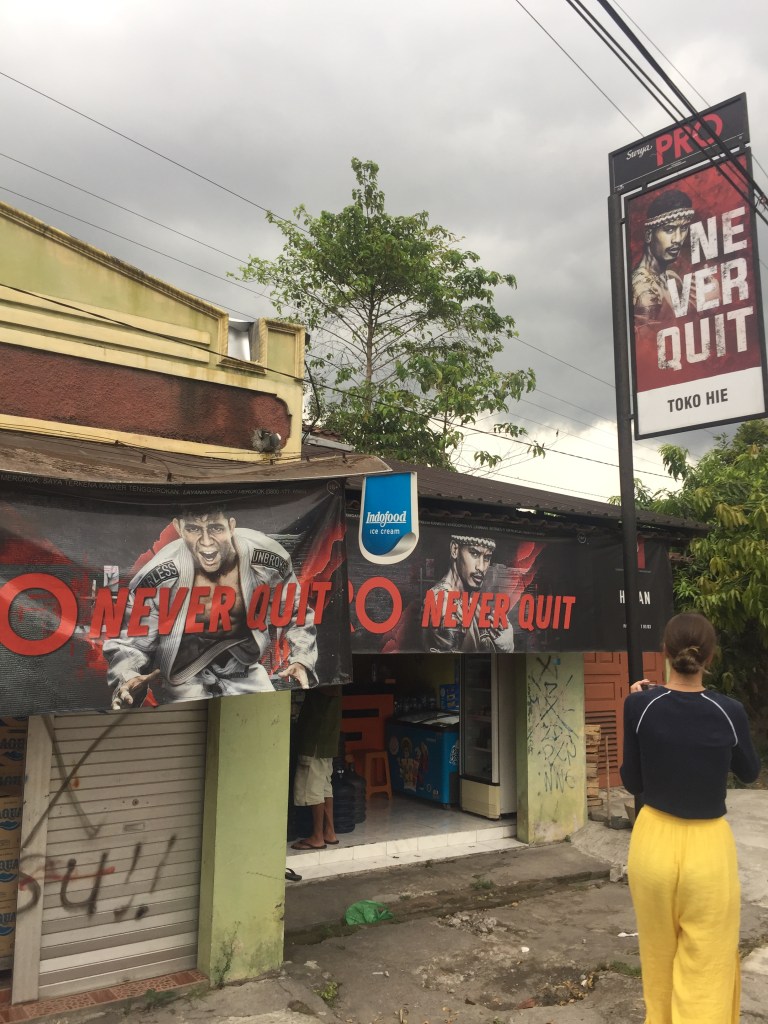
Smoking Campaign, Borobudur, 2019 (own photo)

Fast forward 22 years later, I share in Reynolds experiences in the sense not much has changed. The lack of advertising control has enabled the tobacco industry to continue to thrive, with it living proof of how impactful design really is. With the rise of a technological era, the exposure of such design is more far-reaching than ever before, from streets to television screens, to the sponsoring of public events, social media and Youtube – media outlets that are more commonly used by Indonesia’s youth.

Gudang Garam’s GG Mild brand Youtube advertisement (2017) clearly advocates the ‘new generation’ as their audience, promoting creativity along side tobacco. Smoking continues to be promoted as a ‘social activity’ or something that is considered ‘cool’, using works by designers as an engaging technique.

Gudang Guram GG Mild Advertisement, 2017

In 2016, Global Health Action conducted a survey with high-school students to investigate how youth perceived cigarette advertising. This study revealed that cigarette ads were perceived as encouraging youths to smoke and that smoking status was consistently associated with perception of cigarette ads. (Global Health Action, 2016)

Not only is the imagery a key aspect of design, but so is placement. Banner design in particular is placed on store fronts in close proximity to schools as a subtle yet strategic method to appeal to youth. (Lamb, 2018)

L.A Bold Cigarette Billboard on Yogyakarta street, 2019, (own photo)
Clas Mild Silver cigarette advertisement on vehicle down Yogyakarta street, 2019, (own photo)

Across Indonesia, more design activism for anti-smoking initiatives is needed. Design is both the problem and the solution, and it effects everything. (Crosby, 2016)

Crosby, A. 2019, ‘Design Activism in an Indonesian Village’, MIT Design Issues, vol. 35, no. 3, pp. 50-63, viewed 19 December 2019, < https://www.mitpressjournals.org/doi/pdf/10.1162/desi_a_00549>.

Medicine Man, How does design affect our lives?, marketing agency, London, viewed 20th December 2019, <https://medicine-man.net/2017/11/07/how-does-design-effect-our-lives/>.

Nichter, M., Padmawati, S., Prabandari, Y., Ng, N., Danardono, M. & Nichter, M. 2009, ‘Reading culture from tobacco advertisements in Indonesia,’ Tobacco Control, vol. 18, no. 2, viewed 20th December 2019, < https://tobaccocontrol.bmj.com/content/18/2/98 >.

Reynolds, C. 1999, Tobacco advertising in Indonesia: “the defining characteristics for success”, viewed 20th December 2019, <https://tobaccocontrol.bmj.com/content/8/1/85.short&gt;.

Yayi P., Arika, D 2016, US National Library of Medicine, How do Indonesian youth perceive cigarette advertising? A cross-sectional study among Indonesian high school students viewed on 20th Dec 2019,<https://www.ncbi.nlm.nih.gov/pmc/articles/PMC5005365/>


POST A: Two parties using design to their advantage

As designers, we hold far more responsibility than ever in this digital world where technology is relied on. A designer has the power to control how a space can be more hospitable and the way the general population consumes context (Role of design in society, chapter 1).

In Indonesia, the tobacco industry has used design to their advantage in order to boost tobacco consumerism. A tobacco company giant that has been notorious in pushing their kretek products to men through heavy graphics is ‘PT Gudang Garam’. In their graphics, they depict masculine men and this notion of masculinity has been further supported by their infamous slogan ‘Kretekeknya lelaki’, meaning ‘man’s cigarette’. This has been successful as more than 62% of their men smoke and 90% of are kretek smokers (Tobacco control, 2009). This graphic design as a form of advertising to a large demographic is dangerous in a country like Indonesia as it has not signed with the ‘WHO-FCTC’ (WHO, 2015) which means mainstream tobacco advertising coverage is still prevalent. So why are the deaths of these men ignored? The tobacco industry is one of the largest source of government revenue (Tobacco control, 2009) and with the backing of the government, the industry thrives.

Masculine graphic advertisement by Gudang Garam. Catherine Reynolds, 1999, Tobacco advertising in Indonesia: “the defining characteristics for success”, viewed 20 December 2019, https://tobaccocontrol.bmj.com/content/8/1/85

The continuous use of political power and design, Gudang Garam held a rock competition in 2007 and a rock festival called Rockinland in 2011. These festivals were again targeted at males, as all of their graphic promotional materials depicted rock symbols which were masculine. Apart from that, Rockinland’s lineup were male rockstars to further portray this lifestyle of ruggedness. Similarly, the Jakarta open which was a male’s tennis event was also sponsored by the tobacco industry. Drawing considerations starting from as simple as masculine graphics to enlisting only male stars ultimately is clever design as each element is cohesively attractive to their male target market.

A graphic poster showcasing Rockin’land’s male dominated lineup. Cranberriesworld, 2011, ‘Rockinland festival lineup’, viewed 20 December 2019, http://cranberriesworld.com/live/concerts/java-rockinland-festival-2011-2011-07-23/.

A communal organisation however, has used this design formula to advocate for a more sustainable future. ‘Kartel Awul Yogyarkata’ holds events targeted at youths, predominately males with their primary focus on encouraging them to trade and sell used clothing. The events are generally held at the few skateparks alongside local punk bands in order to appeal to this demographic. Similarly, they advertise graphically through their cult online presence. Although these events do not have primary involvement with tobacco, they do have anti-smoking zones in the larger areas of these events such as the foodcourt and the thrift stalls which can discourage general smoking there.

A band playing at the Kartel Awul YG event I attended, 2019.
stakeholder map and chain to vaguely show the relationship both parties share with government and people of Indonesia, 2019.

Catherine Reynolds, 1999, Tobacco advertising in Indonesia: “the defining characteristics for success”, viewed 20 December 2019, https://tobaccocontrol.bmj.com/content/8/1/85

Cranberriesworld, 2011, ‘Rockinland festival lineup’, viewed 20 December 2019, http://cranberriesworld.com/live/concerts/java-rockinland-festival-2011-2011-07-23/.

Mimi Nitcher, 2009, ‘Reading culture from tobacco advertisements in Indonesia ‘, tobaccocontrol, viewed 20 December 2019, https://tobaccocontrol.bmj.com/content/18/2/98.

SEATCA, 2010, ‘International artists performing at Indonesian tobacco-sponsored rock festival despite protests’, viewed 20 December 2019, https://seatca.org/international-artists-performing-at-indonesian-tobacco-sponsored-rock-festival-despite-protests/.

World health organisation, 2015, ‘Tobacco control in Indonesia’, WHO, viewed 20 December 2019, https://www.who.int/tobacco/about/partners/bloomberg/idn/en/.

Post A: Design in Context

useme
Context is everything when understanding and solving problems

The scope and influence of Design is seemingly endless and it plays some role in almost every industry, society, and culture today. Design determines the systems, technologies and structures we live by and as these evolve and shift, as does the role and practice of the designer. Human-Centered design researcher Gozde Goncu-Berk explained, “In the last decade, graphic design has gone from being defined largely by style to something that is influenced and can influence international policy, consumption, education and the environment (Drucker and McVarish, 2009).” This limitless flexibility is what makes context a key element in every design problem and solution.

Graduating designers are no longer simply experts in the elements and principles of graphic design, products, architecture or fashion, but equally important is their understanding and approach to the many complex contexts they may need to engage and collaborate with.  Assistant professor of art and design at the University of Wisconsin Milwaukeein, Adream Blair-Early, reinstated this when she explained, ‘New designers are valued as much for their ability to collaborate, innovate and creatively solve problems as they are for their understanding of typography and layout.’

Designers frequently must take into consideration shifting environmental, economic and  technological contexts, but with ever-growing globalisation, one of the most challenging tasks for designers today is working across a diversity of cultures. Without undergoing extensive and immersive research, understanding the needs and sensitivities of a foreign culture can be very problematic. Gozde Goncu-Berk highlighted these difficulties when she said, “Designing for another culture is less intuitive and vulnerable to assumptive thinking; therefore cross-cultural design requires constant validation of design decisions with the users. Designers need to be aware of their biases and assumptions as much as possible to draw insights from the user’s reality.”

For example, the culture of a country such as Indonesia is significantly different to Australia in many ways. Therefore an Australian designer must take time to understand the religious, social and political climate of the country before embarking on any kind of user-centered design. Without gaining this information, the designer cannot assume they know how the locals would interpret, receive, understand or interact with their design.

Throughout their practice designer’s must develop skills in innovation and creativity. These invaluable tools, when implemented in a way that is harmoniously integrated with the given contexts, have the power to significantly reshape and improve global society.

References.

Gonku Berk. G, 2013.’A Framework for Designing in Cross-Cultural Contexts: Culture-Centered Design Process,’ PhD Thesis, University of Minnesota, viewed 18 February 2017, <http://search.proquest.com.ezproxy.lib.uts.edu.au/arts/docview/1429798745/fulltextPDF/ADB579FC5323499CPQ/1?accountid=17095&gt;

Blair-Early, A. 2010, ‘Beyond borders: Participatory design research and the changing role of design,’ Visible Language, Vol.44 ,No.2 ,Pp.207-218.

Xiang, X. 2007, ‘Product innovation in a cultural context: A method applied to Chinese product development,’ Dissertation Abstracts International, Vol.68, No.03, Pp.73-77.

Image

Ahlefeldt, F. ‘It’s not that deep,’ viewed 19 February 2017, <http://www.shakiarenee.net/enough-is-enough/&gt;