
Indonesia is facing very serious tobacco problem. With a population of 260 million, Indonesia has become the biggest economy in South-East Asia. However, more than 225700 people were killed by tobacco-caused disease every year. And more than 469000 children (10-14 years old) and 64027000 adults (15+ years old) continue to use tobacco each day. (Indonesia – Tobacco Atlas, 2019) What is most striking is the growing prevalence of smoking among children. By age 10, 20% had tried smoking, and by age 13, the figure was closer to 90%. (Tjandra, 2018)
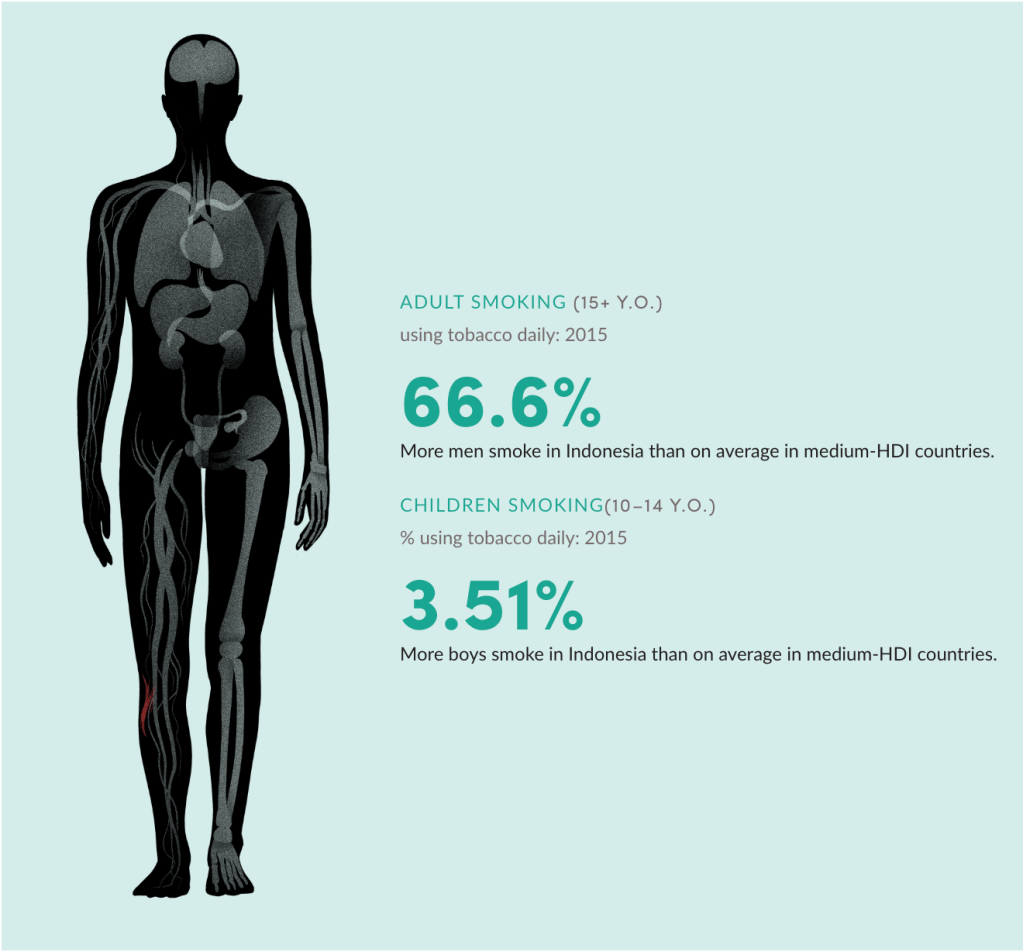

Indonesia – Tobacco Atlas, 2015
Indonesia or is the only country in Asia that has not signed and ratified the World Health Organization’s Framework Convention of Tobacco Control (FCTC). Indonesia is the World’s second largest Tobacco market, tobacco industry has annual sales of more than $21 billion, accounted for 10% of all taxes, It also provides jobs for 2.5 million workers in agriculture and manufacturing. (Tjandra, 2018) There is no doubt that tobacco is a very important industry that supporting Indonesia’s finances, so tobacco companies have significant political and economic influence in Indonesia. This became an important reason for its failure to join FCTC.
And it brings a very serious problem for Indonesia — children smoking. FCTC convention includes: broad ban on tobacco advertising, higher prices and taxes, the printing of health warning labels on tobacco products, and measures to prevent people from accepting passive tobacco in addition to other tobacco control strategies. (World Health Organization, 2019) However, Indonesia is not bound by these provisions. It means in Indonesia, people can see tobacco advertisements everywhere and teenagers can smoke without restraint. This has given Indonesia the ironic nickname——”Tobacco Industry’s Disneyland”. Indonesia is the only country in south-east Asia that allows tobacco advertising. These tobacco companies say they are not targeting for young people who are under the age of 18, and limit their ads to between 9.30pm and 5am to avoid contact with children. (Indonesia Details | Tobacco Control Laws, 2019)
However, teenagers can still easily see those advertisements through many channels, such as roadside shops and restaurants, concerts, sports events and the Internet. Cigarette companies sponsor almost all the country’s concerts and sports events. (Dhumieres, 2019) Those tobacco advertisements deliver very misleading content — smoking means success, charming, courage and popularity. These contents have great appeal to children and teenagers.

Other reasons for childhood smoking are the prevalence of adult smoking and poor government regulation. Adult attraction has a serious effect on their children. In Indonesian families, parents do not avoid their children when they are smoking, and sometimes they even use cigarettes as a reward. Because cigarettes are very cheap in Indonesia. A pack of 20 Marlboros costs $1.55. In Australia, a pack of regular cigarettes costs about $20. (Tjandra, 2018) The cheap cigarettes became a source of comfort for many families. On the other hand, the government has little control over children’s smoking. Although the government banned the sale of cigarettes to minors, the law was never enforced. Teenagers can easily buy cigarettes and cigarettes from supermarkets. Some cigarette companies even distribute free cigarettes to children and teenagers at sponsored events. Prabandari and Dewi made a survey in some high schools in Yogyakarta. According to their study (2016) found that ‘cigarette advertising and incense messages indeed are targeted at char and their Perception was strongly associated with smoking status. Regulations to ban TAPS in order to prevent sanctions from smoking should be applied rapidly in Indonesia. ‘
As Jakarta Reuters said (2019), Indonesia will raise the minimum price of cigarettes by more than a third from January next year, a finance ministry spokesman said on Friday, As part of the government’s efforts to reduce smoking rates. Indonesia still has the lowest cigarette tax in the world. Rising the prices could lead consumers to switch to cheaper cigarette brands, where illegal cigarettes are still easily got in Indonesia. The government must strike a balance between cigarette companies and ordinary people, including promoting health, generating income, employment and supporting local small and medium-sized industries. (Negara, 2019) In this way, the government will not be controlled by cigarette companies and compensate ordinary workers who lose their jobs.
The proliferation of cigarettes is a very terrible phenomenon. Cigarettes are rotting away in Indonesia, so protecting the next generation is the most important problem we need to face. We must avoid our children from the ‘good’ world of cigarettes shows, avoid them from physical and mental destruction which cigarettes caused. We should let our kids have fun at the real Disneyland, not die in the ‘Tobacco Industry’s Disneyland.’

Reference:
Dhumieres, M. 2019, The number of children smoking in Indonesia is getting out of control, Public Radio International. viewed 27 November 2019, <https://www.pri.org/stories/number-children-smoking-indonesia-getting-out-control>.
Indonesia Details | Tobacco Control Laws 2019, Tobaccocontrollaws.org. viewed 27 November 2019, <https://www.tobaccocontrollaws.org/legislation/country/indonesia/summary>.
Indonesia – Tobacco Atlas 2019, Tobaccoatlas.org. viewed 27 November 2019, <https://tobaccoatlas.org/country/indonesia/>.
Jakarta Reuters 2019, Indonesia to raise cigarette prices by more than a third at start of 2020, U.S. viewed 27 November 2019, <https://www.reuters.com/article/us-indonesia-tobacco/indonesia-to-raise-cigarette-prices-by-more-than-a-third-at-start-of-2020-idUSKCN1VY17A>.
Negara, S. 2019, Commentary: The power of Big Tobacco and Indonesia’s massive smoking problem, CNA. viewed 27 November 2019, <https://www.channelnewsasia.com/news/commentary/big-tobacco-indonesia-smoking-problem-cigarettes-tax-raise-11940462>.
Prabandari, Y. and Dewi, A. 2016, How do Indonesian youth perceive cigarette advertising? A cross-sectional study among Indonesian high school students, Taylor & Francis. viewed 27 November 2019, <https://www.tandfonline.com/doi/full/10.3402/gha.v9.30914?scroll=top&needAccess=true>.
Tjandra, N. 2018, ‘Disneyland for Big Tobacco’: how Indonesia’s lax smoking laws are helping next generation to get hooked, The Conversation. viewed 24 November 2019, <http://theconversation.com/disneyland-for-big-tobacco-how-indonesias-lax-smoking-laws-are-helping-next-generation-to-get-hooked-97489>.
World Health Organization 2019, World Health Organization. viewed 27 November 2019, <https://www.who.int/fctc/en/>.


 Indonesia Global Design Studio