POST A: The Parameters Of Tobacco Promotion And Demotion, And The Ethics Of Change. 

Designers provide an ability to contribute positively, negatively or as an agent for change within any context. The parameters influencing them are society, culture and government. A thorough understanding of the stakeholders, product/service and end-user produces effective design solutions that in-turn influence the final outcomes success. Across the world, everything related to tobacco, wether it be the cigarette, packaging or paraphernalia, has been influenced by a designer and Indonesia is no exception to this, actually what they have achieved is rather exceptional.

It would be unjust to hand all the credit to designers. Whilst they play a key role, tobacco’s success to such a high degree is only made possible due to its deeply rooted interdependence in Indonesias socio-cultural, political and economic framework. In order to be an ethical designer, once must consider the determinants that influence tobaccos high prevalence. For Indonesian men, smoking is viewed as a signifier of masculinity (Nawi, 2007), whereas for women, they are a symbol of the new feminist movement (WHO 2012). If one wanted to promote change via methods of design activism, one would understand that to radically eradicate tobacco in Indonesia would be financially devastating to many, a futile solution. The tobacco industry is “a major source of tax revenue for the Indonesian Government” (World Bank, 2001). Although the costs of smoking attributable healthcare expenditures are forecast to cost Indonesia trillions by 2030 (Djutaharta, T. & Vijaya, S., 2003), Tobacco companies within Indonesia provide copious grants and opportunities that far outweigh this. This is evident with examples like Sampoerna University, a University named after a Phillip Morris’ kretek subsidiary cigarette brand. It is widely known that the university offers grants of up to $41,000 US for their top performing students, in addition to various entry-scholarships (The Jakarta Post, 2018).
6dc9bd943c4e65efd3d551f5c5d80886
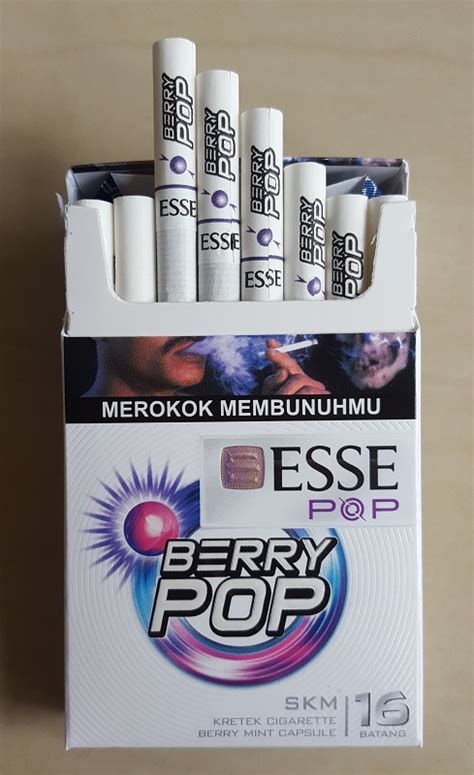
Figure 1- A pack of flavoured Esse cigarettes. With minimal warnings, the bright and colourful packaging and the product itself, it is evidently designed to target young women.
Marlboro Filter Black indonesia Cigarettes front image
Figure 2 – A pack of Marlborough blacks, this brand has strong associations with masculinity.

These practices of promoting cigarettes is in stark contrast to Australia, with a large focus on anti-smoking promotions and campaigns of prevention. In 2006, plain-packaging and graphic warnings in Australia for instance, was a design method implemented for the purpose of the anti-tobacco initiative (The Department of Health, 2018). In Indonesia, the design tactics being used to promote cigarettes and tobacco are transparent.  Whereas in Australia design tactics are bing used to render cigarettes and tobacco as unappealing.

autralia-cigarette
Figure 3 – The evolution of anti-tobacco design tactics with regards to packaging within Australia.

References

Ng, N., Prabandari, Y., Padmawati, R., Okah, F., Haddock, C., Nichter, M., Nichter, M., Muramoto, M., Poston, W., Pyle, S., Mahardinata, N. and Lando, H. 2007, ‘Physician assessment of patient smoking in Indonesia: a public health priority’, Tobacco Control, vol 16, no 3, pp.190-196.

World Health Organization 2012, Tobacco Control in Indonesia, viewed 8 December 2018, <http://www.who.int/tobacco/about/partners/bloomberg/idn/en/&gt;.

Djutaharta, T. & Vijaya, S., 2003, ‘Research on tobacco in Indonesia: an annotated bibliography and review on tobacco use, health effects, economics and control efforts’, HNAP Discussion Paper: Economics of Tobacco Control, No. 10, pp. 1-66.

Indonesia-Investment 2018, Cigarette & Tobacco Industry Indonesia: Rising Pressures in 2018?, viewed 21 December 2018, <https://www.indonesia-investments.com/news/todays-headlines/cigarette-tobacco-industry-indonesia-rising-pressures-in-2018/item8471>

The Department of Health 2018, Smoking Prevalence Rates, viewed 21 December 2018<http://www.health.gov.au/internet/publications/publishing.nsf/Content/tobacco-control-toc~smoking-rates>

Figure 1, cigarettes online store, viewed 21 December 2018, <http://www.cigarettescigs.com> 

Figure 2, The Skeptical Cardiologist, viewed 21 December 2018, <https://theskepticalcardiologist.com/2017/10/08/why-doesnt-the-usa-have-graphic-warning-labels-on-cigarette-packs-like-the-netherlands/>

Figure 3, Clove cigarettes online, viewed 21 December 2018, <https://www.clovecigarettesonline.com/products/marlboro-cigarettes/marlboro-filter-black-clove-cigarettes-details&gt;

POST C: Pride, Prejudice And Tobaccos New Target

IMG_3923
Figure 1 – A local Surabayan woman walking through the Arab District.

In Indonesia, 67.4% of males and 4.5% of females partake in the habit of tobacco smoking (WHO, 2018). Despite it costing billions in healthcare and a growing awareness of the negative effects of both active and passive smoke inhalation, there appears to be little change or incentive in the populace quitting and the amount of new smokers taking up the habit. Reasons for this lack of change are best explored by analysing the public advertising and marketing of tobacco, religious beliefs, sociology and gender.

The act of smoking amongst Indonesian males is viewed as a signifier of masculinity and a way to increase their social status (Nawi, 2007), this has been the zeitgeist since its inception into their culture. Because of this long-term and widely held sentiment, the male market for tobacco in Indonesia has reached a saturation point. However, existing today is a rapidly increasing rate of smoking among Indonesian women (Ng et al. 2007). As Indonesia is experiencing a new wave of feminism, tobacco companies are targeting young women by promoting cigarettes as “torches of freedom” (WHO, 2012), marketing them to be synonymous with defiance and independence. For these women, their choice in wether or not to smoke poses a series of conflicts between personal desires as well as social and religious expectations (Pampel, 2006). The experiences of those desires, pressures and expectations are represented though the perspective of my interviewee Nyssa Putri.

Speaking with the twenty one year old, Surabayan, graphic design student — Nyssa expressed that smoking for women in Indonesia is considered by many as “lower-class and for sex-workers” (2018) with a particular emphasis on the word “taboo” (2018). She expanded on this phrase citing that education of the health risks related to tobacco (especially for females) is “taboo” (2018) and consequently “not talked about” (2018). Despite Nyssa being a well-educated female, she actively partakes in smoking. When asked why she simply smiled, showed off a few of her tattoos and stated “I am a modern Indonesian, I enjoy smoking to relieve the stress of my studies, a lot of us here (at ITS) do” (2018). Her eyes gleamed as she affectionately described how she and her friends like to build towers in the ashtray on the balcony of her home where they would study together.

Tobacco advertising in Indonesia is largely aspirational and subliminally engrained within sponsorships of many youth events. In conjunction to their tactics of marketing and associating themselves with desirable lifestyles, the branding of many new cigarettes target young women. This is achieved through more ‘feminine’ – flavoured cigarettes and colourful packaging. For our interview, Nyssa kindly brought a series ‘Esse’ cigarettes among them were her favourites ‘Honey Pop’ and ‘Berry Pop’. She laid them out on the table, describing the satisfaction of “breaking the ball” and “inhaling the flavour” (2018).

6dc9bd943c4e65efd3d551f5c5d80886
Figure 1 – A packet of ‘Berry Pop’ Esse cigarettes

Regardless of the conflicting messages within Indonesian culture toward women smoking, Nyssa seems to possess all the qualities that Tobacco companies would want their consumer to have. She is a “modern Indonesian” (2018), adopting a more ‘westernised’ lifestyle, is defiant toward the patriarchy and eager to practice her acts of defiance by being, as she says, “one of the boys” (2018). In summary, our conversation provided valuable insight into the perception of cigarettes and the identity it promotes for women. This proved valuable with regards to the conceptualisation of my teams solution, one that possessed a heavy focus on facilitating a positive identity with non-smoking.

References

World Health Organization 2018, Tobacco Control in Indonesia, viewed 8 December 2018 <http://www.who.int/tobacco/about/partners/bloomberg/idn/en/>.

Ng, N., Prabandari, Y., Padmawati, R., Okah, F., Haddock, C., Nichter, M., Nichter, M., Muramoto, M., Poston, W., Pyle, S., Mahardinata, N. and Lando, H. 2007, ‘Physician assessment of patient smoking in Indonesia: a public health priority’, Tobacco Control, vol 16, no 3, pp.190-196.

World Health Organization 2012, Tobacco Control in Indonesia, viewed 8 December 2018, <http://www.who.int/tobacco/about/partners/bloomberg/idn/en/>.

Fred C. Pampel 2006, Gobal Patterns and Determinants of Sex Differences in Smoking, viewed 21 December 2018 <https://journals.sagepub.com/doi/abs/10.1177/0020715206070267>

Figure 1, Image captured by Maddison Rutter-Malley (2018).

Figure 2, Figure 1, cigarettes online store, viewed 21 December 2018, <http://www.cigarettescigs.com> 

POST A: Designing for local contexts through primary research

As designers, we do not only carry the responsibility to design for functional and aesthetic purposes, we also bear the weight of developing solutions that respect the contexts we are designing for. To do so, we must realise that “We individually and collectively make the city through our daily actions and our political, intellectual and economic engagements. But, in return, the city makes us” (Harvey 2003) and thus it is our duty to immerse ourselves into the culture and its traditions to gain a holistic understanding. ‘The city’ in this case, refers to Banjarmasin, Indonesia, the capital of South Kalimantan and otherwise known as the ‘River City’ or ‘City of a Thousand Rivers’.

When placing Indonesia’s social and political contexts under a microscope, it is revealed that each island has a unique identity that has “an aura of beauty, sensuality, chaos and violence” (McDonald 2014) as it is an archipelago. Through observing Banjarmasin and the way local inhabitants moved amongst its urban spaces, it became apparent that designing successfully for different contexts requires “cultural competence and awareness” and “[breaking] free of culturally bound positions” (Piper 2008). This can be achieved by conducting primary research through interacting with local inhabitants and exposing oneself to local events and traditions; both of which provide experiences that secondary research cannot.

Through observing the interactions between local market vendors and tourists in Banjarmasin, it was revealed that it is not only the physical urban landscape that shapes a city’s charm, it is the people that inhabit the space. Their determination to take pictures with bule (Piper 2008) highlighted that Banjarmasin was a city untouched by tourism, rather, it was a city that was embedded in its traditions. This ultimately impacts the design process as it must be ensured that the local people and their traditions are respected. As designers originating from a different context, this may prove to be challenging as it may defy our own values and cultures. Hence, it is crucial that we undertake primary research that allows us to immerse ourselves in the culture practically.

IMG_0851
Local market vendor at Banjarmasin’s traditional markets (San 2018)
IMG_0859
Local traditional markets in Banjarmasin (San 2018)

An example of this is was our visit to the local floating markets, an iconic part of Banjarmasin’s identity. In interacting with the women in the boats selling locally grown produce, the status of women in Banjarmasin was observed and realised. While the typical ideology of ‘the good wife and mother’ (Robinson & Bessell 2002, p.69) continues to exist in Banjarmasin, witnessing women operating the floating markets is a testament to the changing roles of women in Indonesia overall. Such realisations are detrimental to designing for the local people and could not have been realised without engaging in local traditions.

IMG_0696-2
Pasar Terapung – Banjarmasin’s floating markets (San 2018)
IMG_0719
Women of Pasar Terapung (San 2018)

There is no ‘correct’ answer for what design means for local contexts however it is apparent that they are shaped by the people who inhabit the space we are designing for. Ultimately, the role of a designer is not limited to developing a solution to a problem, instead it requires understanding the context they are designing for through interaction with local inhabitants and participation in local traditions. This fills the void that is left behind by secondary research and ensures that what is produced satisfies the people utilising the local space.

REFERENCES: 

Harvey, D. 2003, ‘The Right to the City’, International Journal of Urban and Regional Research, vol. 27, no. 4, pp.939-941.

McDonald, H. 2014, Demokrasi: Indonesia in the 21st Century, Black Inc, Collingwood, Victoria.

Piper, S. 2008, gang re:Publik Indonesia-australia creative adventures, Gang Festival Inc. Newtown.

Robinson, K. & Bessell, S. 2002, Women in Indonesia: Gender, Equity and Development, Institute of Southeast Asian Studies, Singapore, viewed 31 January, < https://books.google.co.id/books?id=ulVcGGCTkxkC&dq=women+in+indonesia&source=gbs_navlinks_s>

San, W. 2018, Local market vendor at Banjarmasin’s traditional markets.

San, W. 2018, Local traditional markets in Banjarmasin.

San, W. 2018, Pasar Terapung – Banjarmasin’s floating markets.

San, W. 2018, Women of Pasar Terapung.

Post C: Terasmitra

As Festival Mata Air was an event focussed on bringing community together to create local environmental and social awareness, this meant there was an array of artistic and environmentally conscious groups at the festival. One that I found particularly intriguing was Terasmitra. During our visit in Indonesia, I had the pleasure of interviewing representatives, Sofia and Kiki and gaining an in-depth knowledge of what their company represented. 

logo.png

Terasmitra’s ultimate goal is ensuring that small communities market their product successfully in order to be adequately paid for their day-to-day needs.

Its primary areas of focus are on craft, food, eco tourism and knowledge management.  Terasmitra actively markets its brand online via Facebook and offline by attending festivals, events and exhibitions. In order to achieve its vision and in line with its environmental values, it actively uses local resources. Empowering women by encouraging them in the workforce is another initiative that accesses community resources and ultimately reinforces its sustainability ethos. Again, highlighting its commitment to its goal, Terasmitra works with companies that have been given benefits from the Small Grants Programme.

At the festival, Terasmitra had a range of products on display. Extremely striking was a range of hand-woven products, which included pencil cases and bags. Intrigued by these I asked about their origins. It was explained that one of Terasmitra’s partners is “House of Lawe”. Based in Yogjakarta, Lawe was founded in 2004 by five women who were concerned about losing the traditional craft of weaving. Terasmitra’s role in this partnership is to “help entrepreneurs market their products” as Kiki states in the interview. This not only ensures that the cultural connection and tradition is kept alive, but also secures financial benefits. The ethos of Lawe is one of encouragement. In particular, the value of the product increases because of the effort put into its creation. 

The women who work at Lawe, work collaboratively to ensure that the raw materials used to make up the end product are not wasted – for example even small scraps of the woven fabric “lurik” (House of Lawe) are put to use by making crafts for a temple or collages for children. Sofia and Kiki state that the main environmental concerns in Indonesia are trash and air pollution. To address this, Lawe implements several waste management strategies. One of its most significant and innovative strategies is its collaboration with researchers directed at harnessing a waste management solution in regards to synthetic dyes. These dyes are inexpensive and can be used widely, so solutions to make these environmentally compatible are critical.

IMG_1006-1024x768

(House of Lawe, 2015)

Terasmitra’s ethical ideologies coupled with carefully selected partners in different fields, ultimately works towards creating a more sustainable and environmentally friendly future. It is also a valuable lesson in how environmentally sustainable solutions do not need to be sacrificed for commercial success.

References 
About 2015, [Homepage of House of Lawe], [Online]. Available: http://www.houseoflawe.com/.

Association Lawe2015, 28 June-last update [Homepage of Terasmitra], [Online]. Available: http://www.terasmitra.com/news/perhimpunan-lawe [2016, 4th of April].
Association Lawe2015, 28 June-last update [Homepage of Terasmitra], [Online]. Available: http://www.terasmitra.com/about-us [2016, 4th of April].
Henry, W. 2015, Dec 2015-last update, THE IMPACT ON THE ENVIRONMENT OF WHAT WE WEAR [Homepage of The Shed Online], [Online]. Available: https://www.theshedonline.org.au/activities/activity/impact-of-what-we-wear [2016, 1st of April].
Higgins, A., Ossedryver, S., Villanueva, C. (2016, February 21). Personal Interview w/ Terasmitra.

HOUSE OF LAWE: empowering women through design {Post C}

The emancipation of women has been extensively recognised as a central goal in international development, in an interview with Fitria Werdiningsih from House of Lawe, we can see just one example of how the empowerment of women through financial liberty is aiding the goal of international development.

House of Lawe is a community social enterprise based in Yogyakarta, Indonesia, that transform traditional hand-woven fabrics into functional products while aiming to contribute to the empowerment of women. All products are designed and produced in traditional Indonesian hand-woven fabrics, and sold both locally and internationally in the US and Japan. Not only are products sold for income, but House of Lawe also has a “Craft Class” initiative, which, is used as a learning centre for developing traditional hand-woven handicrafts.

While it is not a new phenomenon for women in Indonesia to contribute financially to their households, House of Lawe “aims to encourage more women to do so” (Werdiningsih, F. 2016, pers. Comm., 6 April). The workshops are aimed at “empowering women, by encouraging them to, and giving them the means to earn their own income” (Werdiningsih, F. 2016, pers. Comm., 6 April). By these processes, the women who are involved in House of Lawe, are able to contribute to their households financially, substantially improving the household nutrition and raising aspirations for their children’s education.

The conservation of traditional techniques is something that House of Lawe holds as very important to them. While they use new fabrics to create their products, they are also an environmentally conscious enterprise and aim to put measures in place to counteract their environmental impact of their products. One method in which they do this is through the craft classes they run. It is through these craft classes that they aim to teach to the participants the importance of recycling; to do this, their very first crafting module is ‘How to use leftover fabric in order to create economic value’. In this module, they use left over fabrics to make patchwork toys.

House of Lawe have two separate areas they dwell in – business and social. In terms of business, House of Lawe sources “ Lurik”, a traditional Javanese hand-woven fabric; this fabric is traditionally used only for clothing and traditional ceremonies, however, House of Lawe aim to promote the development of Lurik in order to surpass traditional uses and branch out into fashion accessories such as bags, wallets, pouches, home décor and even company merchandise. In regard to their social relationship, House of Lawe “work with local communities, sharing [their] knowledge of industry, business and handicrafts in order to elevate women. [They] share technical, marketing, and entrepreneurial skills.” (Werdiningsih, F. 2016, pers. Comm., 6 April)


House of Lawe 2015, Our Work 3, viewed 6 April 2016. http://www.houseoflawe.com/portfolio/craft-class/

House of Lawe 2015, Conserving Tradition, Empowering Women, viewed 6 April 2016, http://www.houseoflawe.com/

Indonesia-Product.com 2016, Tracing the History of Lurik Fabric, viewed 7 April 2016, http://indonesia-product.com/forum/index.php?topic=2540.0

POST C: Art and Design Collectives in Indonesia – Karina Smole

Art and Design Collectives in Indonesia

Art and Design in Indonesia has blossomed since the end of the Suharto dictatorship, fuelled by the people’s desire for self expression and in response to a changing urbanised landscape. (Modern Art Edition 2012) Under the rule of Suharto, the arts were very much segregated to the formal and the traditional. In discussion with visual comunications student Intan Purnamasari, it appears the contemporary arts scene is still very much driven from, or responding to, traditional arts and crafts. “There is lots of Batik and Wayang, which are traditional arts, we still want to maintain and keep the culture of Batik and Wayang.” (2015, pers. comm., 29 April) However, while keeping that tradition alive, Intan explains that there are modern interpretations of these artforms. Similarly in painting, a uniquely Indonesian hybrid of modern and traditional exists – for example the works of Gusti Agung Istri, an female artist part of the Seniwati Arts Collective. Her paintings are highly refined and traditional, yet also have modern references in technique and composition.

Progressive collectives such as The Seniwati Arts Collective are extremely important in expanding modern arts and design in Indonesia. Intan laments that she believes the contemporary art and design scene, in her experience, is something you have to actively seek in her home city of Jakarta (2015, pers. comm., 29 April) – it is still something quite underground. Seniwati promotes female Indonesian artists in the alternative sphere of arts – rejected by the mainstream. They currently represent 22 artists that are highly diverse – producing contemporary works to traditional paintings. As well has having a permanent gallery space in Batu Bulan, they have also established ‘The Imagination Club’ where neighbourhood children develop their creativity and artistic talents. (Modern Art Edition 2012) The group is encourages and empowers women and their role in the arts scene, where they are hugely under-represented. The collective has a very important place in a changing the Indonesian art scene and is gradually gaining international recognition. (The Jakarta Post 2012,)

As Indonesia progresses and changes, influenced by globalisation and urbanisation processes, this is reflected in the contemporary arts scene. Intan identified the high density of the population, and subsequent traffic and pollution issues as key problems in her experiences of living in Jakarta. (2015, pers. comm., 29 April) The expansion and over-crowding of cities brings up questions of identity, that tradition and tighter-knit community living perhaps once solidified. Artists such as Mella Jaarsma question what constructs identity in works such Moral Pointers (Modern Art Edition 2012). Indonesian artists and designers are responding to a changing environment, where the search for new senses of identity firmly shapes their practices.

mella-jaarsma

Mella Jaarsma’s ‘Moral Pointers’

(Modern Art Edition 2012)


References:
2015, pers. comm., 29 April

Modern Art Edition 2012, Indonesian Contemporary Art, Indonesia, viewed 20 April 2015, <http://www.modernedition.com/art-articles/indonesian-contemporary-art/indonesian-contemporary-art.html&gt;

The Jakarta Post 2012, Arts Collective Evolution, Jakarta, Indonesia, viewed 29 April 2015, < http://www.thejakartapost.com/news/2012/12/27/artists-collective-evolution.html&gt;